
You Have Gas Logs. Do You Still Need a Chimney Sweep?
August 23, 2026 · Houston Air Pure Team
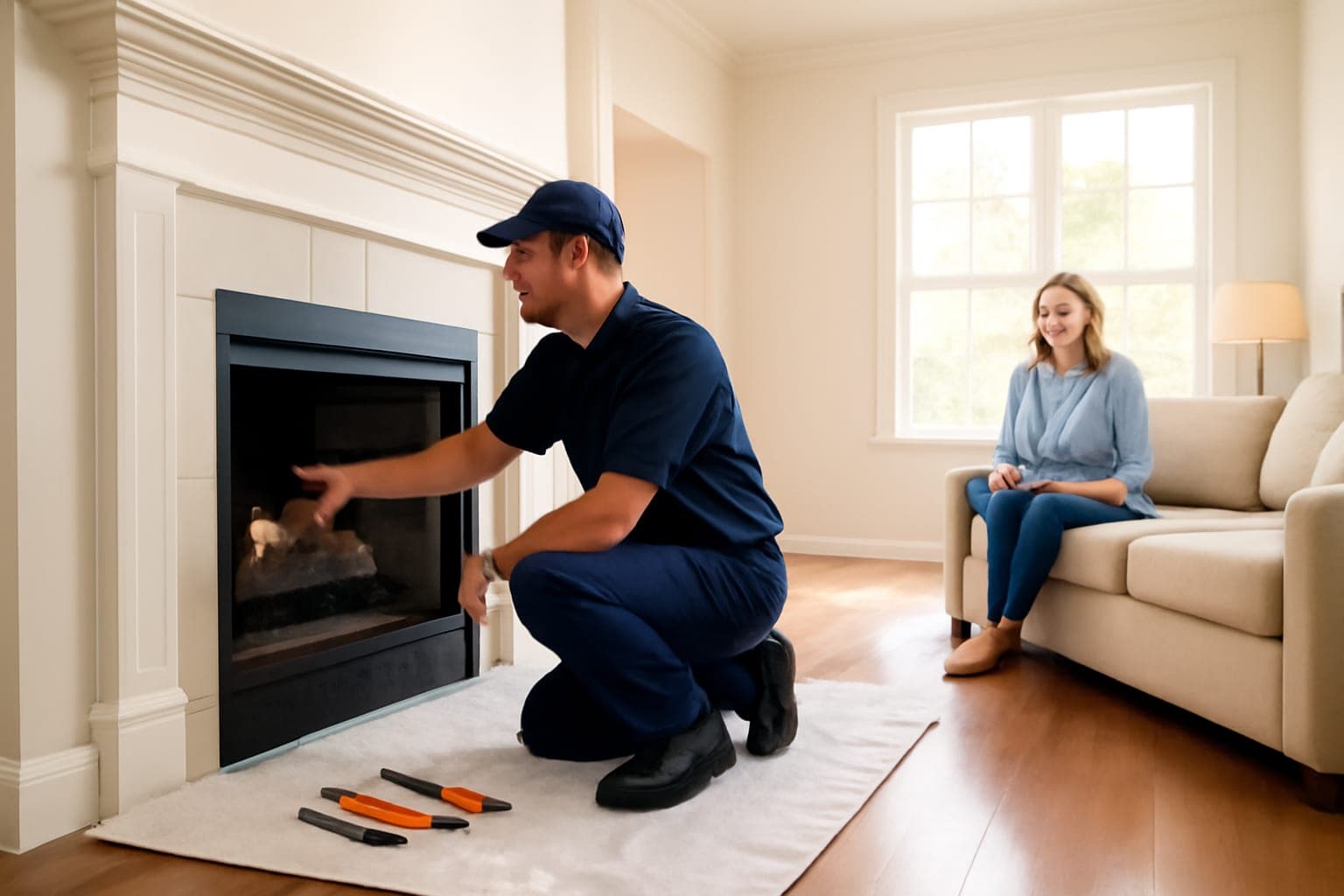
Somewhere around half the fireplaces we look at in the Houston metro have never burned a piece of wood. Gas logs, a wall switch or a key valve, and a firebox that gets used four or five evenings a year when a norther comes through.
The question that follows is completely reasonable: if there is no wood, there is no creosote, so what exactly would a sweep be sweeping?
It is a fair question and the honest answer is more nuanced than either extreme you will hear on the phone. Gas absolutely reduces what a chimney needs. It does not reduce it to nothing, and the things it does not fix are the ones that cause the expensive damage.
What Gas Actually Changes
Burning wood deposits creosote — a tarry, combustible residue that builds on the flue walls and is the reason wood-burning chimneys need regular sweeping. A properly operating gas appliance burns far cleaner and produces essentially none of it.
So the classic sweep, in the sense of brushing heavy deposits out of a flue, mostly does not apply to a vented gas-log set. If someone quotes you a full creosote removal on a gas fireplace that has never had wood in it, they are quoting a service you do not need.
That is the part of the pitch to push back on. Now the part people get wrong in the other direction.
What Gas Does Not Change At All
The chimney is still a masonry structure with a hole in your roof at the top of it. Gas has no opinion about any of the following, and all of them are things we find on Houston gas fireplaces regularly.
Water intrusion. A cracked crown, a rusted chase cover, failed flashing, or spalling brick lets rain in exactly the same way whether the firebox burns gas, wood, or nothing. Houston gets enough rain in a bad week to do real damage through a small opening, and the first symptom is usually a smell or a stain rather than a visible leak.
Animals and nesting material. An uncapped or poorly capped flue is an attractive cavity. Birds, squirrels, and wasps do not care what fuel you burn, and a nest is a blockage regardless.
Blockage and draft. Gas combustion produces carbon monoxide and water vapor that have to leave the house. A blocked flue on a wood fire announces itself with smoke in the room. A blocked flue on a gas fire does not announce itself at all, which is precisely what makes it dangerous.
Deterioration of the liner. Gas exhaust is cooler and carries a lot of moisture. In an older unlined or clay-lined masonry chimney, that moisture condenses and can be mildly acidic, which degrades mortar joints over years. Ironically, some older chimneys deteriorate faster on gas than they did on wood.
The Three Things We Find Most Often
First: a damper that was never properly clamped. A vented gas-log set requires the damper to stay open, and the code-correct way to guarantee it is a damper clamp or a permanently removed damper plate. We regularly find neither — a homeowner opens the damper by hand before lighting, and one evening someone forgets. That is a carbon monoxide event in a closed-up house.
Second: a cap that is gone, crushed, or was never there. This is the cheapest repair on the list and it prevents the two most expensive problems, rain and animals. If you cannot remember whether you have a chimney cap, you probably do not.
Third: debris resting on the log set. Mortar crumbs, brick fragments, and nesting material fall down the flue and land on the burner and the logs. It obstructs ports, it changes how the flame burns, and it is the usual cause of soot on gas logs — which should be burning nearly clean.
Vented vs. Vent-Free — Know Which You Have
This matters and most homeowners do not know the answer.
A vented gas-log set is designed to run with the damper open and exhaust up the chimney. It looks the most like a real fire and it puts most of its heat up the flue.
A vent-free (or ventless) set is designed to burn with the damper closed and exhaust into the room. It is far more efficient as a heater, it is regulated differently and prohibited in some jurisdictions and in certain rooms, and it puts a significant amount of water vapor into your house — which in Houston humidity is not a small consideration.
The two are not interchangeable and running one as though it were the other is genuinely unsafe. If you inherited the fireplace with the house and nobody ever told you which it is, that alone is worth an inspection.
What an Inspection on a Gas Fireplace Covers
It is a shorter visit than a wood-burning sweep and it should cost less. What we are checking:
The flue, top to bottom, for blockage, nesting material, and liner condition. The cap, crown, and chase cover from above. The damper, and whether it is clamped correctly for the appliance you have. The log set placement, because gas logs have to sit in specific positions relative to the burner or they produce soot and carbon monoxide. The firebox and the connection point. And the room itself for a working carbon monoxide alarm, which we will mention every time, because it is the single most valuable ten dollars in this entire discussion.
If everything is sound, we tell you that and you are done. That happens often on newer homes and it is a perfectly good outcome.
How Often, Realistically
For a gas-log fireplace in a Houston home used a handful of evenings a year, an inspection every couple of years is sensible, plus a look after any major roof work, any storm that took shingles off, or any period where the house sat vacant.
For a chimney with no cap, an older masonry structure, or a history of any water intrusion, annually until it is sorted out.
The timing that makes sense here is fall. Nobody thinks about a fireplace in Houston until the first genuinely cold night, and then everyone calls the same week. We wrote about that seasonal crunch in why Houston fireplaces fail in December, and it is a real pattern — the fall inspection is easy to book and the December one is not.
Book a Look
We inspect and service gas and wood chimneys across the metro Monday through Saturday — Katy, The Woodlands, Sugar Land, Cypress, Spring, Pearland, Humble, Missouri City, Richmond, and Tomball.
Details on scope are at chimney sweeping and repair. Tell us it is gas when you call — the visit and the price are different, and we would rather quote you correctly than sell you a wood-burning service you have no use for.